
A Robotic Door Trim
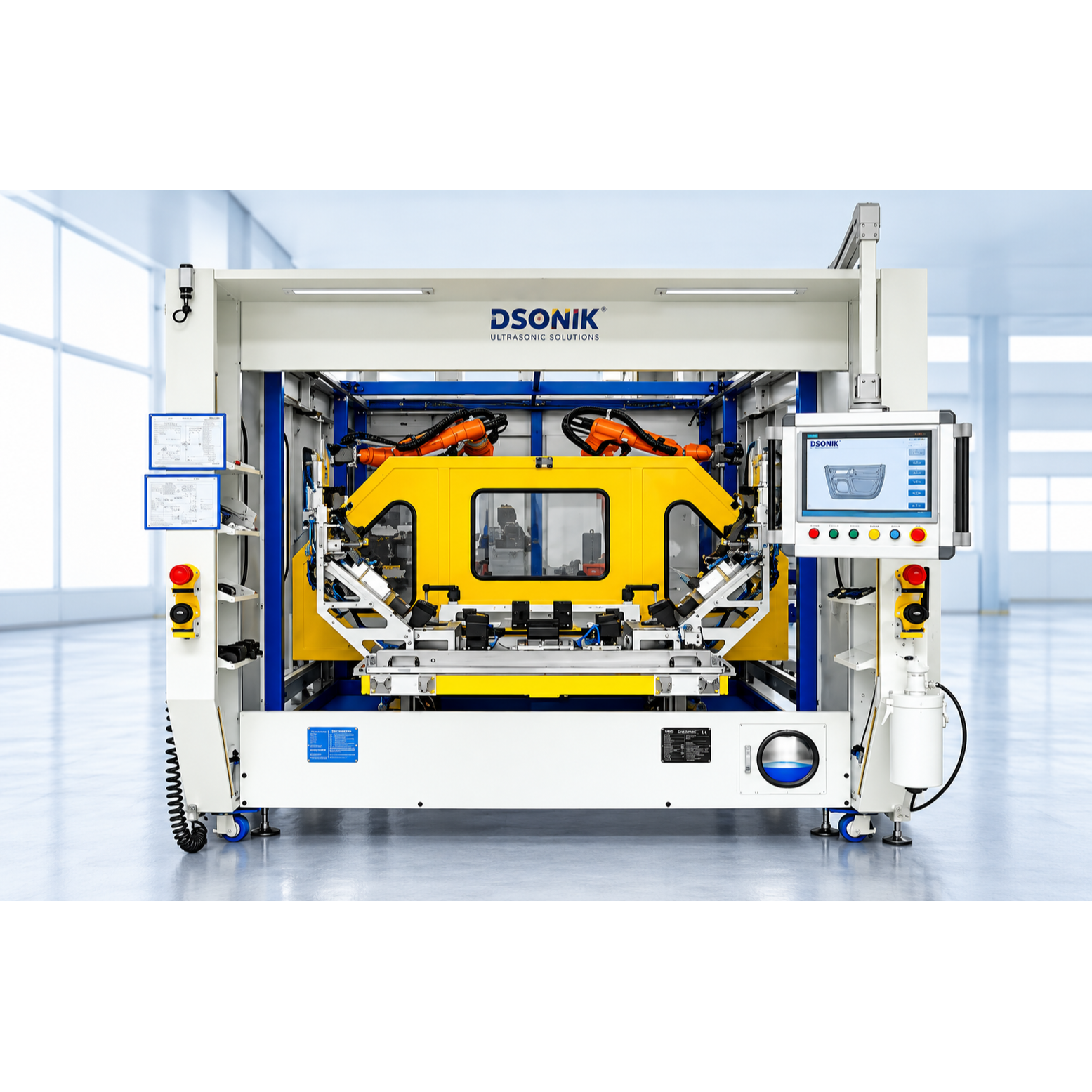
Ultrasonic Spot Welding Machine automates
multi-point welding of plastic
door-trim parts in automotive interiors. A 6-axis robot moves the welding head or component between programmed weld
points.
It welds door trim panels, map pockets, speaker grilles,
armrests, decorative parts, brackets, retainers, insulation, felt
attachments, and other thermoplastic assemblies.
Typical DSONIK
System Configuration
- 6-axis industrial robot for accurate multi-point positioning
- Ultrasonic generator: typically 15 / 20 / 35 / 40 kHz depending
on application
- Robotic ultrasonic actuator/welding head
- Titanium or aluminium ultrasonic
horn/sonotrode
- Customized door-trim holding fixture
- PLC + HMI control system
- Automatic weld-point sequencing
- Recipe storage for different door-trim
models
- Weld time / energy / amplitude control
- Part presence and position sensors
- Welding pressure or force monitoring
- Safety enclosure with interlocked doors
- Optional barcode/QR-code traceability
- Optional weld-data logging and quality
monitoring
Working Principle
The door-trim assembly is
loaded into a custom fixture. After the safety cycle starts, the robot positions the welding head at the first weld point. The horn contacts the plastic boss, applies pressure, and
ultrasonic vibration creates localized heat.
The plastic melts at
the interface and forms the joint. After hold time, the robot moves to the next
point until all welds are complete.
One door panel may require 10, 20, 30, or more ultrasonic spot welds, depending on design.
Major Advantages
Robotic ultrasonic
spot welding is flexible because one cell
can weld many points without separate actuators. It provides fast cycles, repeatable positioning, clean joints, low consumable cost,
programmable parameters, and easy adaptation to new door-trim variants.
It reduces manual work and suits large or
3D automotive components with widely spaced weld points.
Important Design
Point
Weld quality depends on plastic boss design, horn-tip profile, fixture
support, and robot positioning.
The fixture must support the panel near each weld point
to prevent flexing and ensure strong joints.
Common materials
include PP, ABS, ABS-PC, PC/ABS, and other automotive thermoplastics. Final parameters should be validated for
each
material and part geometry.
DSONIK Robotic Door
Trim Ultrasonic Spot Welding Machine can be built as a fully automated solution for automotive plastic interiors. It combines robotic
positioning, precision ultrasonic welding, and custom tooling to deliver consistent, repeatable
multi-point welds for dedicated lines
or
flexible cells.