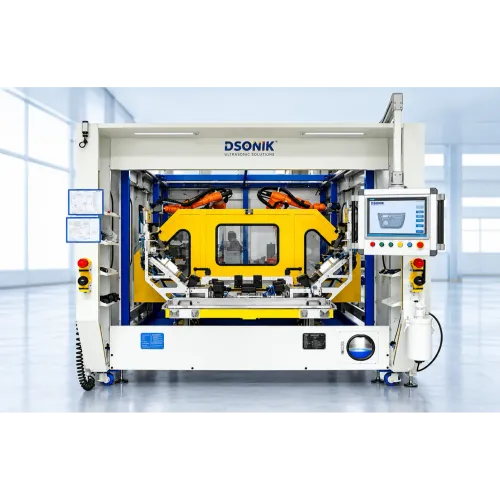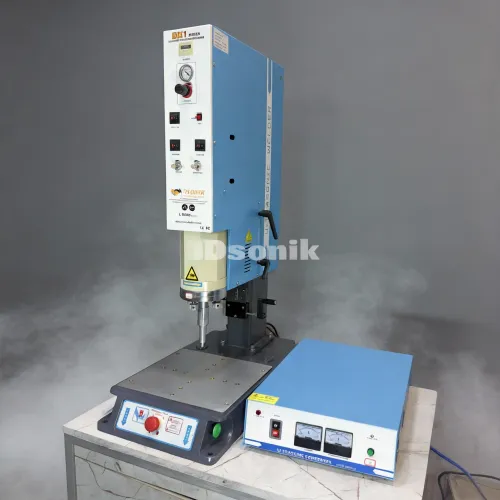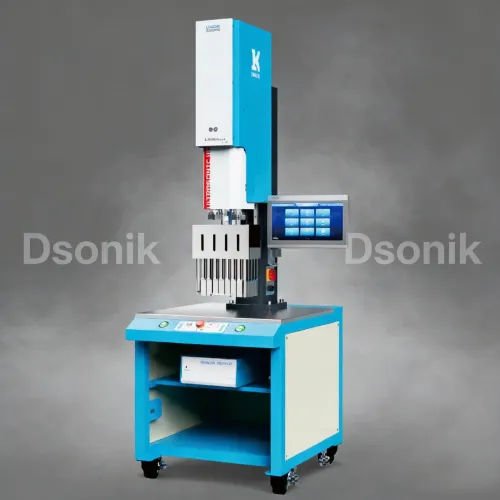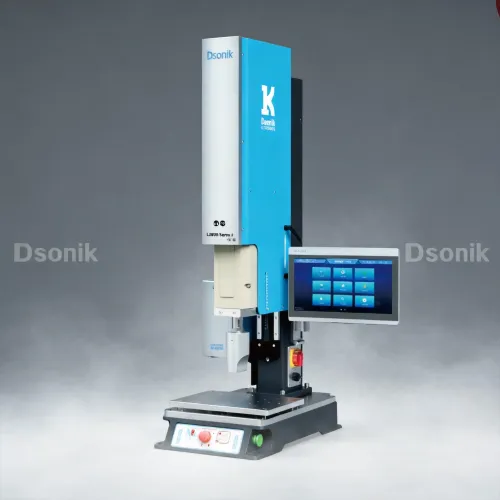

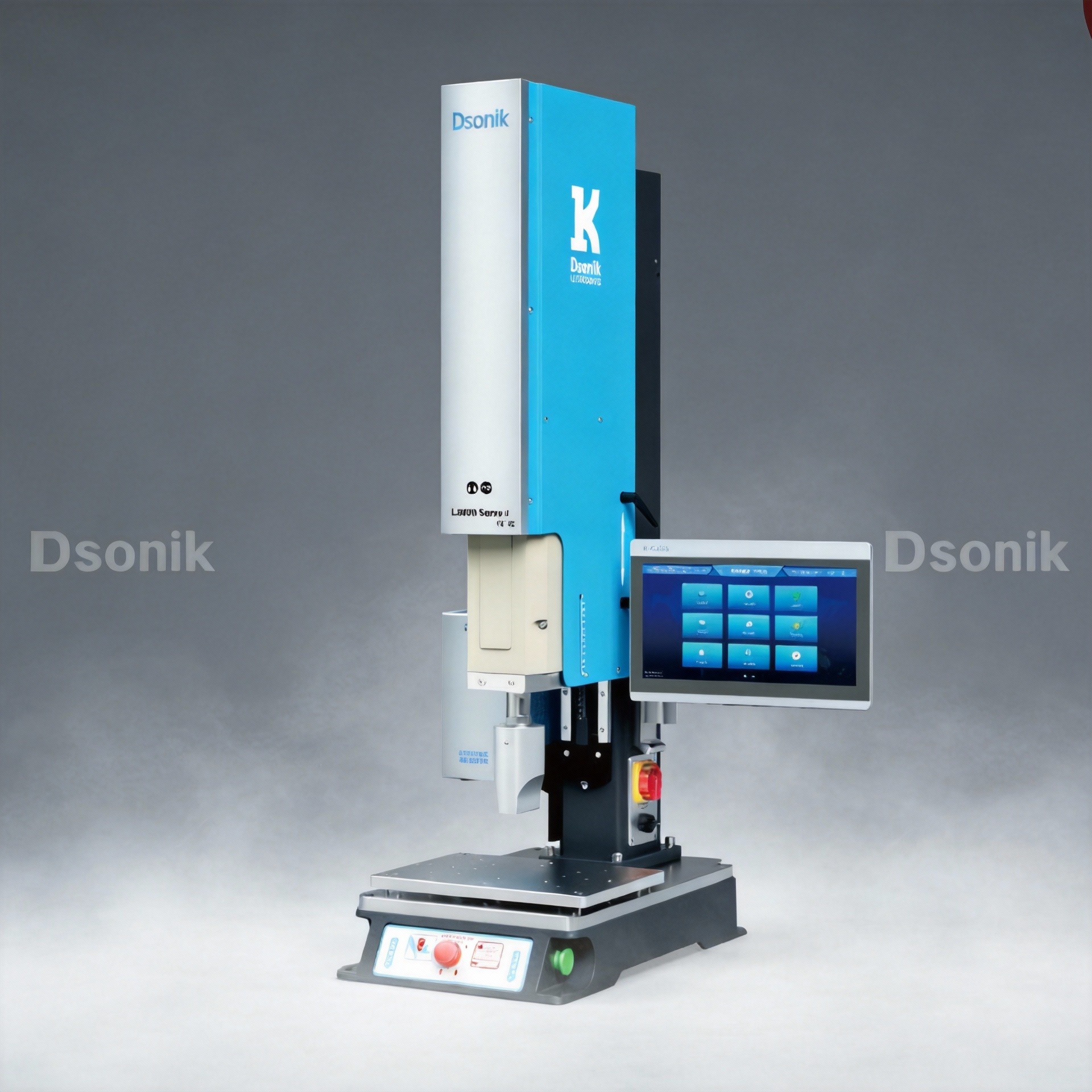
A servo-controlled ultrasonic plastic welding machine uses an electric servo actuator rather than a pneumatic cylinder to precisely control horn movement, force, speed, position, and collapse. It is ideal for applications that require accurate weld depth and consistent results.
The basic system sequence is:
Servo motor → ball screw or linear actuator → ultrasonic stack (converter, booster, and horn) → plastic part → fixture
During welding, the servo controls horn approach, position, and force, while the ultrasonic generator typically delivers vibrations at 15, 20, 30, 35, or 40 kHz.
Compared with pneumatic ultrasonic welding, the main advantages are:
• Accurate weld-depth and collapse control for tight tolerances.
• Programmable horn approach speeds and multi-stage velocity profiles.
• Precise trigger-force control before ultrasound begins.
• Welding by distance, energy, time, peak power, or force.
• Improved repeatability with less dependence on compressed-air fluctuations.
• Recorded force and displacement curves for quality monitoring.
• Simple recipe storage for different components.
• Greater control for delicate, thin-walled, electronic, medical, automotive, and other precision plastic parts.
• For example, if an ABS part requires a 0.45 mm collapse, the servo can approach rapidly, slow near the part, make contact at about 120 N, activate ultrasound, and continue until the exact collapse is reached. Ultrasound then stops while the actuator maintains a controlled hold force as the molten interface solidifies.
• A typical industrial control architecture is:
• HMI/PLC → Servo drive → Servo motor or actuator
HMI/PLC → Ultrasonic generator → Converter → Booster → Horn
• Feedback is provided by the servo encoder, load cell or force sensor, generator power, energy and frequency signals, safety switches, and part-present sensors.
• For a 15 or 20 kHz high-power machine, size the servo according to the required weld force and acceleration, not motor wattage alone. For a maximum weld force of about 2–4 kN, a properly sized ball-screw actuator with a servo motor, brake, absolute encoder, and preferably an independent load cell is a practical solution.
• Servo control is especially valuable for large horns, precision collapse welding, multi-stage weld profiles, and applications where pneumatic systems produce inconsistent weld depth.
• To size the system, specify the frequency (15 or 20 kHz), required weld force, horn weight, and stroke. These inputs can be used to determine the servo motor, ball screw, gear ratio, and PLC/servo control sequence.