
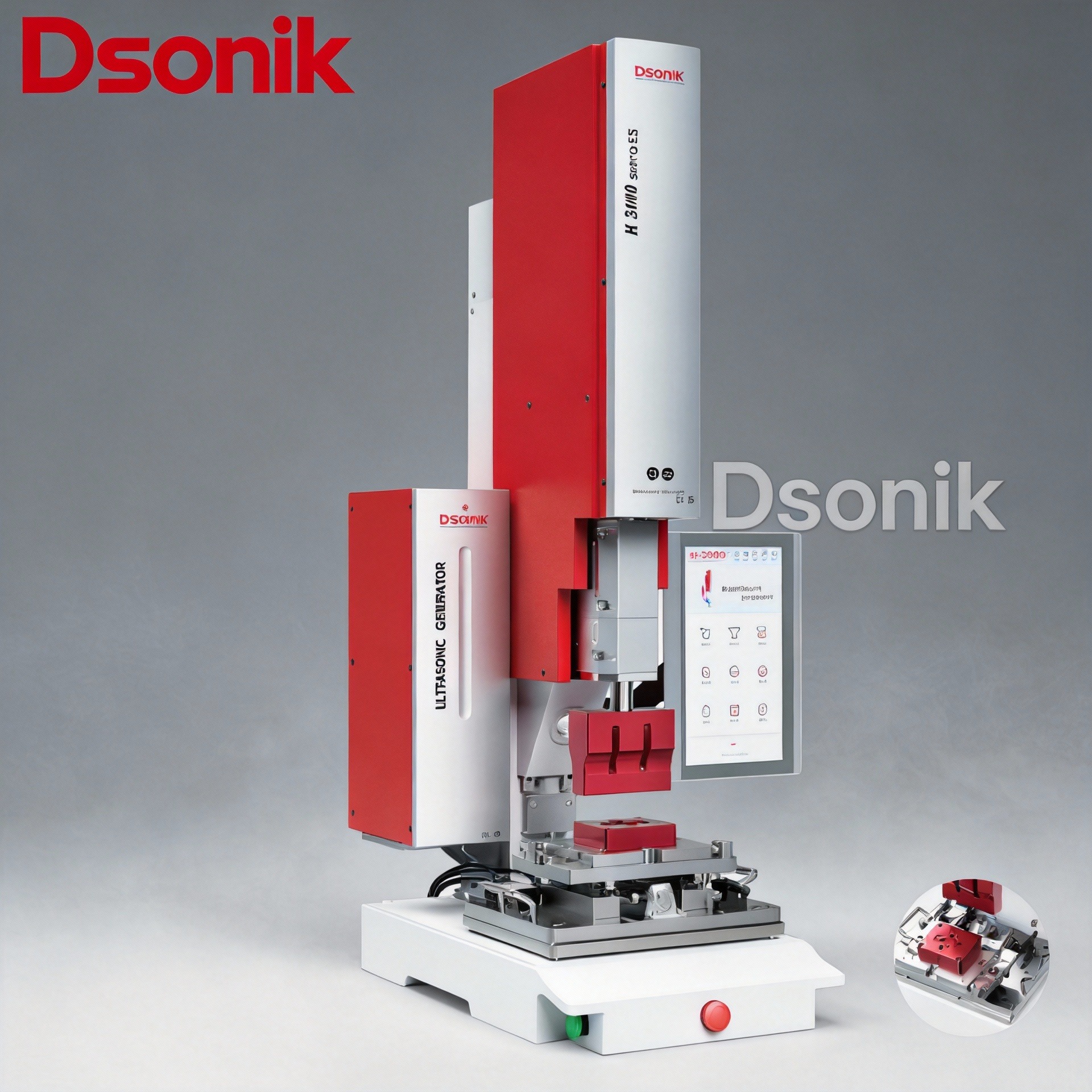
Leakage in ultrasonic-welded polycarbonate (PC) parts usually results from an incomplete or uneven melt seal, poor joint design, excessive part stress, or incorrect process settings. PC welds well ultrasonically, but its process window is narrower than that of softer plastics, making precise horn and fixture alignment and careful energy control essential.
Begin by checking the joint design. Leak-tight PC assemblies require a consistent energy director. A controlled triangular tip concentrates ultrasonic energy and produces continuous melt flow along the seal. Leakage can occur even when the exterior weld appears acceptable if the energy director is too small, damaged, discontinuous, or uneven in height.
Next, inspect horn and fixture contact. The horn must contact the part evenly, and the fixture must rigidly support the weld area to prevent flexing. Uneven support can fully weld one section while leaving another only partially fused. For large or circular parts, verify uniform horn amplitude across the entire weld surface.
Do not try to eliminate leakage simply by increasing weld time or amplitude. Excessive ultrasonic energy can crack PC, create internal stress, produce flash, or damage the sealing surface. Instead, optimize the process systematically:
• Begin with moderate amplitude, then gradually increase energy until the entire sealing path melts evenly.
• Where possible, use weld-by-energy or weld-by-distance/collapse rather than relying only on a fixed weld time.
• Apply enough pressure to maintain full contact, but avoid crushing the energy director before it melts properly.
• Maintain a short hold time after ultrasonics stop so the molten PC solidifies under pressure.
• Set trigger force and approach speed so the horn contacts the part consistently without impact.
• If leakage occurs at one location, inspect that area for warpage, uneven wall thickness, energy-director variation, or fixture deflection.
A weld-collapse study is a useful diagnostic tool. Measure the joint height before and after welding at several points around the part. If one area shows significantly less collapse, the likely cause is mechanical alignment, joint geometry, uneven horn amplitude, or inadequate fixture support—not simply insufficient weld energy.