

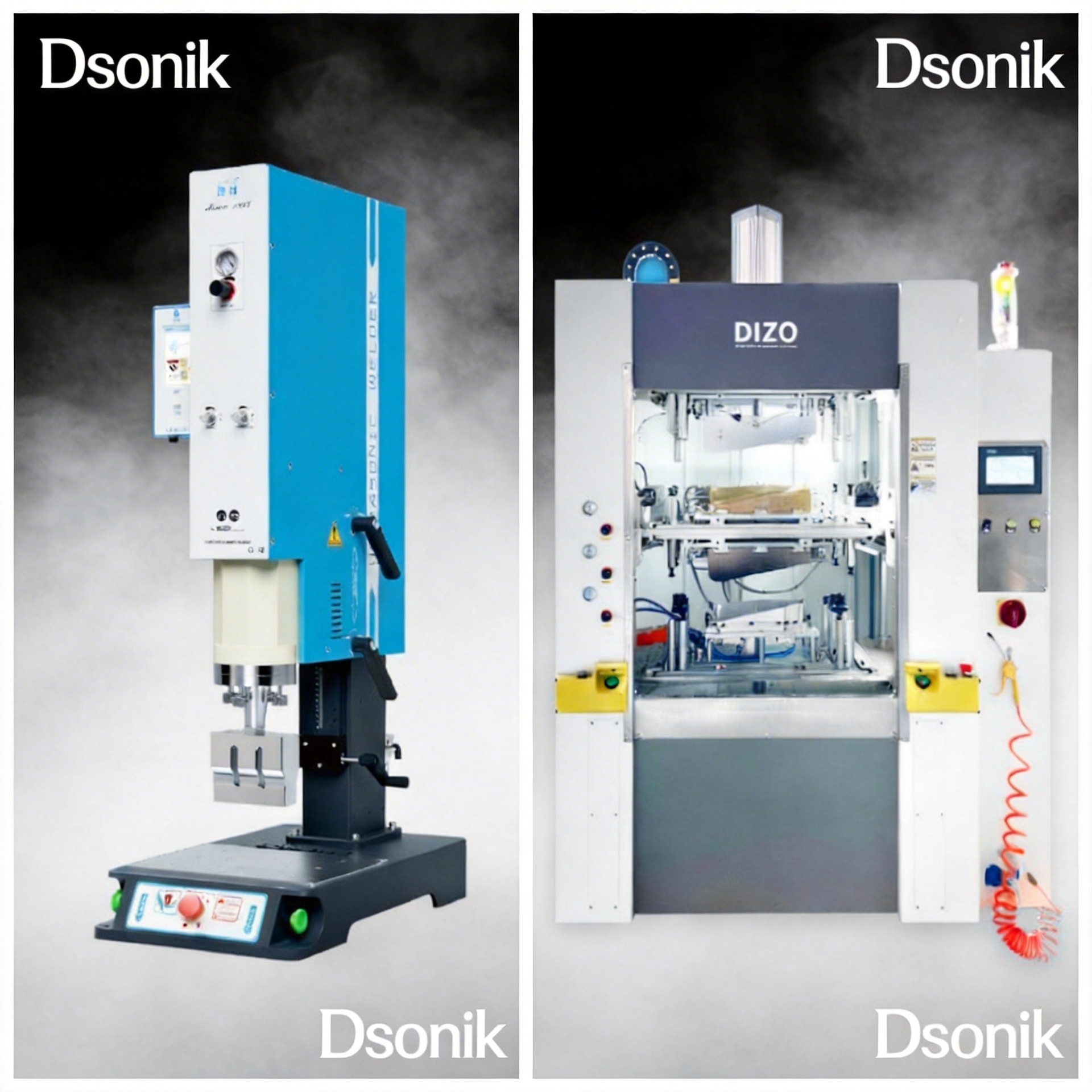
The choice between ultrasonic welding and hot plate welding
depends on several factors related to the application, material, and desired
outcome.
Ultrasonic Welding:
- Process: High-frequency
vibrations (ultrasound) are applied to the parts under pressure,
generating localized heat at the joint interface. This melts the plastic,
and when the vibrations stop, the material cools and solidifies, forming a
weld.
- Advantages: Fast
cycle times (often less than a second), clean process (no external heat
source), suitable for complex geometries, good for delicate components,
low energy consumption post-startup.
- Disadvantages: Limited
to thermoplastic materials, joint design is critical, can be sensitive to
material variations, generally for smaller parts or specific joint
configurations.
- Typical
Applications: Automotive components, medical devices, electronic
enclosures, consumer goods, textiles, packaging.
Hot Plate Welding:
- Process: A
heated platen is placed between the two parts to be joined. The platen
melts the surfaces of both parts. The platen is then removed, and the two
molten surfaces are pressed together and held under pressure until they
cool and solidify.
- Advantages: Capable
of welding larger and more complex parts, accommodates a wider range of
thermoplastic materials (including those with high melting points),
creates strong, hermetic seals, less sensitive to joint design than
ultrasonic.
- Disadvantages: Slower
cycle times (due to heating and cooling phases), requires careful
temperature control, potential for material degradation if overheated, can
produce flash (excess material) that needs trimming, higher energy
consumption during the heating phase.
- Typical
Applications: Automotive fuel tanks, large appliance components,
fluid reservoirs, industrial containers, pipes, HVAC ducts.
In summary, ultrasonic welding is generally preferred for
speed, precision, and smaller-scale applications, while hot plate welding is
chosen for larger parts, robust seals, and a broader range of material
compatibility where cycle time is less critical.
What specific aspects of these two methods are you most
interested in exploring further, perhaps in the context of your optimization
goals?
