
Lower frequency → higher amplitude, generally suited to larger/heavier parts.
Higher frequency → lower amplitude and finer energy delivery, often suited to small, delicate or precision parts.
Frequency Typical character Common applications
15 kHz High-amplitude, heavy-duty Large automotive parts; thick/large plastic assemblies
20 kHz Versatile industrial range Automotive, appliances, filters, housings and general plastic welding
28 kHz Mid-range precision Medium/small parts, electronics and technical assemblies
35 kHz Precision welding Small medical/electronic components and thin walls
40 kHz Fine, low-amplitude welding Miniature/delicate components, films and precision assemblies
15 kHz — Large, Heavy Components
High displacement helps transmit energy through large automotive trim, housings, thick moldings and other difficult assemblies.
Its longer resonant wavelength requires a larger horn.
Large part + higher amplitude → 15 kHz
________________________________________
20 kHz — Industrial Workhorse
Often the first choice to evaluate for industrial welding, balancing amplitude, horn size, power and control.
Uses: automotive parts, filters, electrical housings, consumer products, toys, appliances, battery components and plastic staking.
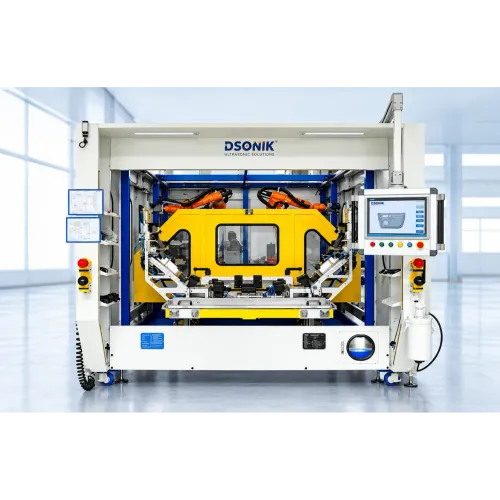
Especially relevant to automotive door-trim and robotic spot welding.
General industrial welding → 20 kHz
________________________________________
28 kHz — Middle Ground
Bridges 20 kHz and precision 35–40 kHz, offering medium-size parts a more compact stack and finer vibration than 20 kHz.
Uses: electrical components, technical assemblies and medium/small molded parts.
Medium part + greater precision → 28 kHz
________________________________________
35 kHz — Precision Welding
Lower displacement and smaller tooling suit small parts vulnerable to marking or damage from excess movement.
Uses: small automotive parts, electrical/electronic assemblies, medical devices, connectors and thin walls.
Small + delicate → 35 kHz
________________________________________
40 kHz — Small, Sensitive Components
Low amplitude and compact tooling suit miniature parts, thin sections, delicate assemblies and minimal cosmetic marking.
40 kHz is not automatically better than 20 kHz: higher frequency limits practical horn size and changes displacement and energy transfer.
Very small + precision → 40 kHz
________________________________________
Horn length generally decreases: 15 → 20 → 28 → 35 → 40 kHz.
Practical selection
Do not select by part dimensions alone. Assess:
Part size → material → joint design → horn-to-joint distance → required amplitude → weld strength → appearance → internal components → horn geometry → required power
Starting points:
Large/heavy → 15 kHz
General industrial plastic part → 20 kHz
Medium/small technical part → 28 kHz
Small/precision part → 35 kHz
Very small/delicate part → 40 kHz
Frequency is not power
“More kHz = more powerful welding” is incorrect.
Frequency and power are separate: compare a 4000 W / 20 kHz generator with a 1000 W / 40 kHz generator. Frequency alone does not indicate available power.
Weld performance depends on:
Frequency + generator power + converter capability + booster/horn gain + actual amplitude + clamp force + joint design + weld parameters
At DSONIK, 15 kHz = large / 40 kHz = small is only a starting rule. Final selection depends on complete part geometry, material, required weld strength, testing method and weld-joint design.