Ghaziabad
08048047758
+919810776728
Ultrasonic Plastic Welding Machine

Robotic Door Trim Ultrasonic Spot Welding Machine

In stockcod not available
Phone Number

08048047758

Please keep 0 before dialling the number.

Email Address info@dsonik.com

Mon-Thu: 10 AM - 2 PM • Fri: 3 PM - 7AM

Other Website Visit our other website
Address Dsonik Ground Floor , Plot No. 74 , Anand Industrial Estate, Mohan Nagar

Ghaziabad, India, 201007
Description

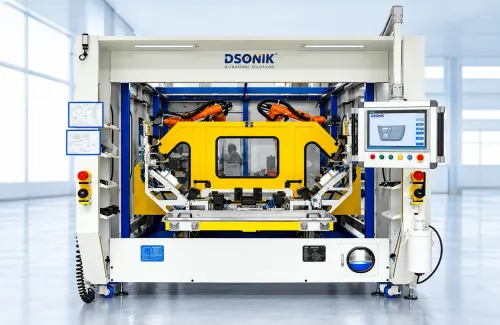
A Robotic Door Trim Ultrasonic Spot Welding Machine automates multi-point welding of plastic door-trim parts in automotive interiors. A 6-axis robot moves the welding head or component between programmed weld points. It welds door trim panels, map pockets, speaker grilles, armrests, decorative parts, brackets, retainers, insulation, felt attachments, and other thermoplastic assemblies. Typical DSONIK System Configuration • 6-axis industrial robot for accurate multi-point positioning • Ultrasonic generator: typically 15 / 20 / 35 / 40 kHz depending on application • Robotic ultrasonic actuator/welding head • Titanium or aluminium ultrasonic horn/sonotrode • Customized door-trim holding fixture • PLC + HMI control system • Automatic weld-point sequencing • Recipe storage for different door-trim models • Weld time / energy / amplitude control • Part presence and position sensors • Welding pressure or force monitoring • Safety enclosure with interlocked doors • Optional barcode/QR-code traceability • Optional weld-data logging and quality monitoring Working Principle The door-trim assembly is loaded into a custom fixture. After the safety cycle starts, the robot positions the welding head at the first weld point. The horn contacts the plastic boss, applies pressure, and ultrasonic vibration creates localized heat. The plastic melts at the interface and forms the joint. After hold time, the robot moves to the next point until all welds are complete. One door panel may require 10, 20, 30, or more ultrasonic spot welds, depending on design. Major Advantages Robotic ultrasonic spot welding is flexible because one cell can weld many points without separate actuators. It provides fast cycles, repeatable positioning, clean joints, low consumable cost, programmable parameters, and easy adaptation to new door-trim variants. It reduces manual work and suits large or 3D automotive components with widely spaced weld points. Important Design Point Weld quality depends on plastic boss design, horn-tip profile, fixture support, and robot positioning. The fixture must support the panel near each weld point to prevent flexing and ensure strong joints. Common materials include PP, ABS, ABS-PC, PC/ABS, and other automotive thermoplastics. Final parameters should be validated for each material and part geometry. DSONIK Robotic Door Trim Ultrasonic Spot Welding Machine can be built as a fully automated solution for automotive plastic interiors. It combines robotic positioning, precision ultrasonic welding, and custom tooling to deliver consistent, repeatable multi-point welds for dedicated lines or flexible cells. DSONIK can also provide a complete machine specification covering robot selection, ultrasonic power, actuator setup, fixture concept, PLC architecture, cycle time, and approximate BOM for door-trim applications.

Keywords

Other Products

view all

6814772a5d263414004dd4a4 Card 2

product image
Ultrasonic Plastic Welding Machine

A Robotic Door Trim Ultrasonic Spot Welding Machine automates multi-point welding of plastic door-trim parts in automotive interiors. A 6-axis robot moves the welding head or component between programmed weld points. It welds door trim panels, map pockets, speaker grilles, armrests, decorative parts, brackets, retainers, insulation, felt attachments, and other thermoplastic assemblies. Typical DSONIK System Configuration • 6-axis industrial robot for accurate multi-point positioning • Ultrasonic generator: typically 15 / 20 / 35 / 40 kHz depending on application • Robotic ultrasonic actuator/welding head • Titanium or aluminium ultrasonic horn/sonotrode • Customized door-trim holding fixture • PLC + HMI control system • Automatic weld-point sequencing • Recipe storage for different door-trim models • Weld time / energy / amplitude control • Part presence and position sensors • Welding pressure or force monitoring • Safety enclosure with interlocked doors • Optional barcode/QR-code traceability • Optional weld-data logging and quality monitoring Working Principle The door-trim assembly is loaded into a custom fixture. After the safety cycle starts, the robot positions the welding head at the first weld point. The horn contacts the plastic boss, applies pressure, and ultrasonic vibration creates localized heat. The plastic melts at the interface and forms the joint. After hold time, the robot moves to the next point until all welds are complete. One door panel may require 10, 20, 30, or more ultrasonic spot welds, depending on design. Major Advantages Robotic ultrasonic spot welding is flexible because one cell can weld many points without separate actuators. It provides fast cycles, repeatable positioning, clean joints, low consumable cost, programmable parameters, and easy adaptation to new door-trim variants. It reduces manual work and suits large or 3D automotive components with widely spaced weld points. Important Design Point Weld quality depends on plastic boss design, horn-tip profile, fixture support, and robot positioning. The fixture must support the panel near each weld point to prevent flexing and ensure strong joints. Common materials include PP, ABS, ABS-PC, PC/ABS, and other automotive thermoplastics. Final parameters should be validated for each material and part geometry. DSONIK Robotic Door Trim Ultrasonic Spot Welding Machine can be built as a fully automated solution for automotive plastic interiors. It combines robotic positioning, precision ultrasonic welding, and custom tooling to deliver consistent, repeatable multi-point welds for dedicated lines or flexible cells. DSONIK can also provide a complete machine specification covering robot selection, ultrasonic power, actuator setup, fixture concept, PLC architecture, cycle time, and approximate BOM for door-trim applications.

6814772a5d263414004dd4a4 Card 2

product image
Ultrasonic Cleaning Machine

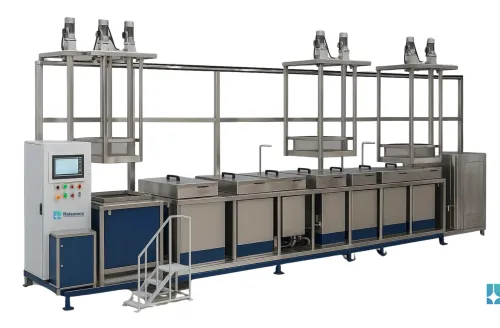
Custom Industrial Ultrasonic Cleaning Machine is engineered around the customer's actual component, contamination, production volume, and required cleanliness rather than using a standard tank size. Industrial systems can incorporate customized tank dimensions, ultrasonic frequency/power, filtration, oil separation, PLC/HMI automation, automated material handling, rinsing and drying stages. For DSONIK, this can be positioned as a premium engineered product: DSONIK Custom Industrial Ultrasonic Cleaning Systems Engineered for Your Component. Designed for Your Process. What DSONIK can customize Parameter Possible configuration Tank capacity 50 L to 5,000+ L Tank material SS304 / SS316L Frequency 25 / 28 / 40 kHz or application-specific Ultrasonic power Customized according to tank and load Heating Electric heating with temperature control Cleaning stages Ultrasonic Wash → Rinse → Final Rinse → Dry Filtration Continuous recirculation + cartridge/bag filtration Oil removal Oil skimmer / coalescing system Automation PLC + HMI Component handling Basket lift / pneumatic lift / gantry / conveyor Drying Hot-air / vacuum drying Process monitoring Time, temperature, ultrasonic power, alarms Construction Heavy-duty industrial design Safety Interlocks, E-stop and application-specific protection Custom systems in the market already extend to 5,000+ L, automated multi-stage configurations and high-power installations, so this is a realistic product category for large industrial applications. DSONIK can offer these machines for Oil & Gas, automotive, aerospace, railways, marine, heavy engineering, precision manufacturing, power plants and maintenance/MRO facilities. Ultrasonic systems are particularly useful for removing oils, grease, machining residue, carbon, particulates and other contamination from complicated geometries. DSONIK OGC Series – Heavy-Duty Ultrasonic Cleaning System A strong configuration would be: Dirty component → Pre-cleaning → Ultrasonic cleaning → Filtration/oil separation → Rinse → Hot rinse → Drying DSONIK ready to export for Saudi Arabia, UAE, Kuwait, Oman, Qatar, Norway, Kazakhstan, Mexico, Nigeria, Algeria, Libya, Angola, and Venezuela these custom industrial ultrasonic cleaning machine in capacity of 500 L, 1,000 L, 2,000 L and 5,000 L systems with filtration, oil skimming and automatic lifting.

6814772a5d263414004dd4a4 Card 2

product image
Ultrasonic horn

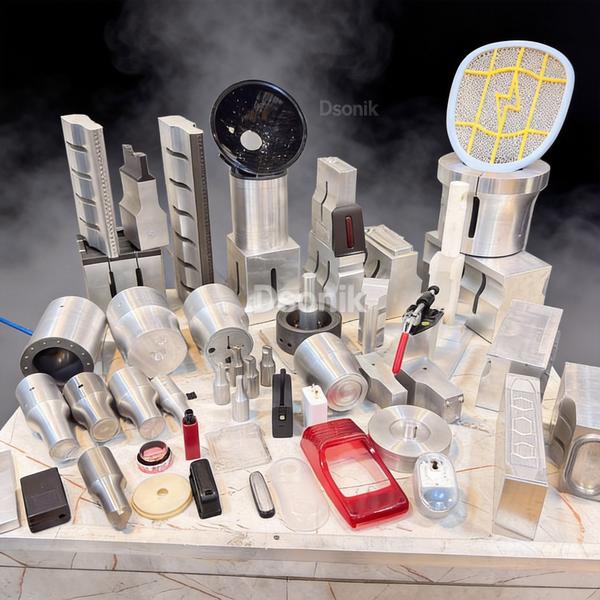
An ultrasonic horn (also known as a sonotrode) is a critical component in high-power ultrasonic plastic welding systems. It is a tapering metal bar that acts as an acoustic transformer, transferring vibrational energy from the ultrasonic transducer to the material being worked on. Its primary job is to amplify the amplitude of the vibration and match the acoustic impedance to the workload. Dsonik founder member have 23 year experience of horn manufacturing. Dsonik manufacture ultrasonic horn for any brand ultrasonic plastic welding machine. Dsonik use high quality grade aluminum and titanium alloy. Dsonik manufacture various frequency range ultrasonic horn (15, 20 22, 28, 30, 35, 40, 50 KHZ)